


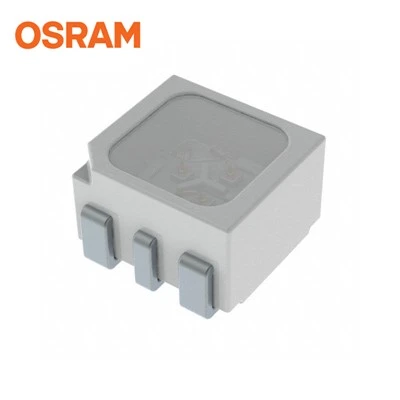
GW JCLPS2.CM-GWH3-XX53-1-65-2 ams OSRAM DURIS E 3 5000 K at CRI 90
- The code, resolved. GW JCLPS2.CM-GWH3-XX53-1-2 is ordering number Q65112A8960, a 5000 K part spanning 27.0 to 33.0 lm, in full production. The full commercial string adds the 65 mA test current, the binning set and the 330 mm reel.
- The brightest colour point in this CRI 90 family. Six of the seven colour temperatures open at 24.0 or 25.5 lm; only 5000 K opens at 27.0 lm, and it is the only row carried by the GWH3 pair.
- CRI 90 minimum, 92 typical, R9 at 50 minimum — the grade that separates this device from its CRI 80 sibling, which reaches 40.5 lm at the identical colour point.
- Forward voltage lands at 2.85 V typical, inside a window running 2.70 V to 3.00 V. Continuous drive spans 10 mA to 150 mA, with a 200 mA ceiling for pulses of 10 µs or less.
- A slim 3.03 × 1.35 mm body standing 0.7 mm high, 9.3 mg, sealed to MSL 3 and shipped 10 000 to a 330 mm reel. The thermal figure of 38 K/W rests on a 46 % radiant-efficiency assumption; strip that out and the real path sits nearer 70 K/W.
Description
Product Introduction
At one colour point, 5000 K, this part and its CRI 80 sibling share a package, a current, a footprint and a datasheet family. They do not produce the same light. The CRI 90 device delivers 27.0 to 33.0 lm; the CRI 80 version reaches 31.5 to 40.5 lm. That difference - roughly 4.5 lm at the floor and 7.5 lm at the ceiling - is what colour rendering costs, and it is the first number a specifier should see.
Where this code sits inside its own family is the other reason to order it. Across the seven colour temperatures from 2700 K to 6500 K, six start at 24.0 or 25.5 lm. Only 5000 K carries the GWH3 pair, and only 5000 K opens at 27.0 lm. A design that needs CRI 90 and as much light as the family can give lands here.
The rest is settled: R9 at 50 minimum, 2.85 V typical at 65 mA, a 100 °C operating ceiling, MSL 3, and 10 000 pieces to a 330 mm reel. Ordering number Q65112A8960, in full production.
Key Product Features
1. A Colour Grade With a Price in Lumens
CRI 90 minimum and R9 50 minimum lift the rendering far above the 80 / 0 of the standard grade, and the bill arrives as output: 27.0 lm at the floor where the CRI 80 part starts at 31.5 lm. Whether that trade is worth taking is a project decision, not a component one.
2. The Top of the Family's Output Ladder
Of the seven colour temperatures offered, 5000 K alone opens at 27.0 lm and alone uses the GWH3 pair. A buyer who has been quoted a 4000 K or 5700 K part to hit a flux target is looking one rung below where this family actually peaks.
3. Four Brightness Groups in a 6 lm Band
GW starts the band at 27.0 lm and H3 ends it at 33.0 lm, with H1 and H2 filling the space between. The group name sits in the first field of the reel label, so a fixture with a written output figure can be ordered to a rung rather than to the whole span.
4. Radiant Efficiency Sets the Thermal Number
The 38 K/W figure assumes a radiant efficiency of 46 % and is quoted on the electrical basis. Strip that assumption away and the real path sits near 70 K/W. The figure is honest - it is simply the one to compare against a part quoted the same way, not against a bare number.
5. A Colour Window Tighter Than the Warmer CCTs
The 5000 K three-step ellipse runs 0.0081 by 0.0035 in Cx and Cy, narrower than the 4000 K window at 0.0094 by 0.0041. Cooler colour points in this family carry tighter bins, so a CRI 90 5000 K build also gains a little colour tolerance.
| Parameter | Typical Value |
| Manufacturer | ams OSRAM |
| Product Series | DURIS E 3 (Generation 2), CRI 90 |
| Ordering Code | Q65112A8960 |
| Colour Temperature (CCT) | 5000 K (bin XX53 / A333), centre Cx 0.3446 / Cy 0.3551 |
| Luminous Flux (IF = 65 mA) | 27.0 to 33.0 lm (bin pair GW…H3) |
| Forward Voltage (IF = 65 mA) | 2.85 V typ. (2.70 to 3.00 V) |
| Forward Current | 10 mA min. / 150 mA max. (200 mA surge) |
| Viewing Angle | 120° (Lambertian) |
| Colour Rendering Index | 90 min., 92 typ. (R9 50 min.) |
| Thermal Resistance (RthJS) | 38 K/W electrical (ηe = 46 %) |
Application Fields
A CRI 90 emitter changes which rooms it belongs in. The manufacturer's own list names area lights, downlights and spotlights, lamp retrofits, mood lighting and table lamps - interiors where colour is judged by eye, and where the extra rendering earns its keep. Typical specifications include:
- Retail shelf and display lighting – merchandise colour has to read true under the source, which is the whole case for paying for the higher grade.
- Hotel, restaurant and bar interiors – hospitality schemes where food, timber and fabric are assessed visually rather than measured.
- Residential downlights – domestic rooms with skin tones and wood finishes permanently in view.
- Table and desk lamps – the manufacturer's fifth named use, and the one where a CRI 90 part is specified most often.
- Area and panel lights – broad, even illumination across an open interior.
- Linear lighting runs – unbroken strips, with the 1.35 mm width letting emitters sit close together.
- Lamp retrofits – drop-in engines for candle and tubular housings.
- Mood and cove lighting – concealed runs where the source stays out of the field of view.
- Display cases and jewellery lighting – small enclosed volumes with the source sitting close to the goods.
- Narrow-aperture spotlights – small openings feeding a mixing chamber a few millimetres deep.
Why Choose Gainer LED?
- Fourteen years in the LED component trade
A decade and a half of sourcing these parts means the awkward questions - which bin, which reel, which revision - get answered from experience rather than looked up.
- One order covering several lines
Emitters, drivers and optics can travel on a single purchase order and a single shipment, so a build is not held up waiting on the last line to clear.
- A portfolio spanning many manufacturers
We are not tied to one brand. Where a second source or a comparable part makes sense, we can quote it instead of steering you back to the only line we carry.
- Coverage of the models most stockists skip
The unusual bins and the low-volume colour points are the ones that go out of stock first elsewhere. Those are the references we work to keep on the shelf.
- A named contact who replies the same working day
Every account has one person who knows the history of the order, so a follow-up question does not start again from the beginning.
FAQ
Q: Why does the CRI 90 version cost more and deliver less light than the CRI 80 one?
A: Because the two are graded differently. The higher grade guarantees a colour rendering index of 90 minimum with R9 at 50 minimum, where the standard part guarantees 80 with R9 at zero. Holding that tolerance across production costs output: at 5000 K the CRI 90 device spans 27.0 to 33.0 lm and the CRI 80 device spans 31.5 to 40.5 lm. You are buying colour accuracy, not lumens.
Q: We need the strongest 5000 K output at CRI 90. Is this the right reference?
A: Yes, and it is the only one. Across the seven colour temperatures in this CRI 90 family, six open at 24.0 or 25.5 lm; 5000 K alone opens at 27.0 lm and alone carries the GWH3 pair covering 27.0 to 33.0 lm. If the target is maximum flux at this colour grade, this colour point is where the family tops out.
Q: If the 5000 K part is out of stock, can we use the 4000 K or 5700 K version?
A: Not without a design change. Both are rated 25.5 to 31.5 lm, so the floor drops 1.5 lm and the ceiling 1.5 lm, and the colour point itself moves - 4000 K reads noticeably warmer and 5700 K cooler. A fixture whose output figure was written around the 5000 K row would need that figure revisited. We can supply either, but treat it as a substitution, not a swap.
Q: Which projects actually justify paying for the higher colour grade?
A: Interiors where people judge colour by eye and the goods or surfaces matter. Retail display, hospitality, residential rooms with visible skin tones and timber, and display cases. In a warehouse, a car park or a back-of-house corridor, the standard CRI 80 grade does the same job for less. The grade is worth its cost only where someone will notice.
Q: How do we make sure we are ordering the CRI 90 part and not the CRI 80 one?
A: By the middle field of the part number. CM denotes the CRI 90 device and EM the CRI 80 device; everything else in the string - the 5000 K bin, the 65 mA test current, the 330 mm reel - can look identical. Quote the ordering number as well, since Q65112A8960 belongs only to the CRI 90 version. Two parts this close deserve the extra field on the paperwork.
Hot Tags: GW JCLPS2.CM-GWH3-XX53-1-65-2 ams OSRAM DURIS E 3 5000 K at CRI 90, China GW JCLPS2.CM-GWH3-XX53-1-65-2 ams OSRAM DURIS E 3 5000 K at CRI 90 manufacturers, suppliers, factory, SFH 309 FA 4, SFH 4059SR, BPW 34 S, GW JTLMS3 CM G8GW XX51 1 60 R33, GW JTLPS1 CM JMKM XX57 1, GW QSLPS1 EM LWLZ XX57 1 150 R18
Send Inquiry
You Might Also Like
-

ams OSRAM LY A676-Q2T1-26 High-Power Ultra-Warm Whit...
-
ams OSRAM LRTBGVSG-VCVE-24+AOAQ-79+THTJ-OQ-20-S-XX A...
-

ams OSRAM LY T67F-U2V2-34-1-20-R18-Z Ultra-High CRI ...
-

ams OSRAM PLT5 520DB_P High-Power White LED for Prec...
-

ams OSRAM SFH 4715A High-Intensity Infrared IR LED P...
-

ams OSRAM OSLON® SSL 80 High Power Red LED GR CS8PM1...