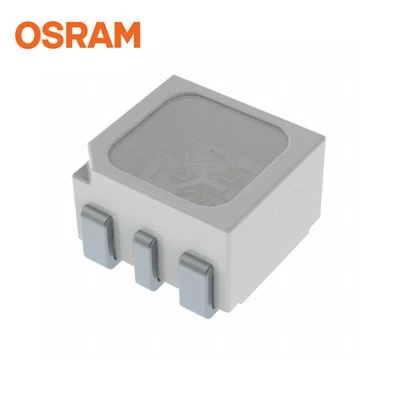

GW JTLPS1.CM-JMKM-XX56-1-150-R33 3500K CRI 90 ams OSRAM DURIS® E 2835
- JMKM-XX56-1 is the 3500 K row at five McAdam steps — Q65113A2630, 56.0 to 76.0 lm at 150 mA across five bins from JM to KM.
- The same colour is also sold at CRI 80 — KLLL-XX56-1 on Q65113A2652 runs 68.0 to 88.0 lm, twelve lumens higher at the floor and twelve at the top.
- Operating ceiling stops at 85 °C here, against 100 °C for the CRI 80 part — the junction limit is 125 °C in both documents, so the ambient margin is what the grade changes.
- Six forward-voltage groups, 2.70 to 3.30 V in total — 0.60 V of spread where the CRI 80 sheet prints two groups over 0.20 V, so a resistor-fed string sees three times the window.
- CRI 92 typical with R9 at 50 minimum — LM-80 results listed among the features, a 120° Lambertian beam, a 3.5 × 2.8 × 0.7 mm footprint, and moisture level 3 on the bag.
Description
Product Introduction
At 3500 K this catalogue sells one white twice. Q65113A2630 is the high-rendering version, 56.0 to 76.0 lm over five brightness bins; Q65113A2652 is the same colour point at CRI 80, 68.0 to 88.0 lm. Both sit at Cx 0.4077 and Cy 0.3929, so the difference is not the tint.
Twelve lumens separate them at the floor and twelve again at the ceiling. The rest of the cost is paid elsewhere: the CRI 90 sheet stops at an 85 °C operating ceiling where the CRI 80 sheet allows 100 °C, and it spreads forward voltage over six bins between 2.70 and 3.30 V against two groups over 2.80 to 3.00 V.
What the grade buys is rendering - CRI 92 typical, R9 at 50 minimum. The body measures 3.5 by 2.8 by 0.7 mm and the beam is Lambertian at 120°, so a standard 2835 pad takes it without a change to the board.
Key Product Features
1. Two Grades at a Single Colour Point
3500 K is sold as CRI 90 at 56.0 to 76.0 lm and as CRI 80 at 68.0 to 88.0 lm, and both are aimed at Cx 0.4077 / Cy 0.3929. The tint does not move with the grade, so the choice is about light and heat rather than about colour.
2. The Operating Ceiling Drops With the Rendering
The CRI 90 document stops at 85 °C while the CRI 80 document for the same body allows 100 °C, and both cap the junction at 125 °C. Fifteen degrees is the difference between an open downlight and a sealed one.
3. Six Voltage Groups Over 0.60 V
K2 through N1 run from 2.70 to 3.30 V on this grade, against two groups spanning 2.80 to 3.00 V on the other. A string fed through a resistor sees three times the spread, so a constant-current driver is the easier design.
4. Rendering That Holds Red
Rendering lands at 90 minimum, 92 typical, with R9 holding 50 - the figure that decides whether a red fabric or a timber veneer keeps its colour. The CRI 80 grade at the same colour point carries R9 at zero, so reds and timbers are where the difference shows first.
5. The Efficiency Headline Is a 4000 K Figure
The front page quotes 148 lm/W, and a 168 lm/W figure at 65 mA, both taken at 4000 K. At 3500 K the manufacturer's own page pairs 66 lm with 0.44 W, which comes to roughly 150 lm/W at the 150 mA test point - a slightly better number, for a different colour from the one in the headline.
| Parameter | Typical Value |
| Series | DURIS™ E 2835, type string GW JTLPS1.CM, from ams OSRAM |
| Ordering Number | Q65113A2630, for JMKM-XX56-1 |
| Colour Point | Cx 0.4077 and Cy 0.3929, the 3500 K centre |
| Brightness Window | 56.0 to 76.0 lm over five groups, graded at 150 mA |
| Forward Voltage | 2.94 V typical, six bins between 2.70 and 3.30 V |
| Drive | 10 to 250 mA working range, with a 300 mA surge held to 10 µs |
| Rendering | CRI 90 floor and 92 typical, with R9 at 50 |
| Thermal Basis | 25 K/W at 40 % radiant efficiency; 125 °C junction, 85 °C operating |
| Moisture Level | MSL 3, with a 168-hour floor clock once the seal is broken |
| Outline | 3.5 × 2.8 mm, 0.7 mm tall, Lambertian at 120°, 20.0 mg |
Application Fields
- Hotel guest-room downlights – a warm white that keeps timber and textile tones apart.
- Restaurant and bar table pendants – low fittings where the plate and the room both have to read correctly.
- Retail apparel walls – fabrics compared against each other on one rail.
- Furniture and cabinet showrooms – veneer and paint samples judged under the light they will be sold in.
- Reception and lobby feature walls – a wash where the wall finish is the product.
- Aged-care bedhead and corridor fittings – warm light at close range for long hours.
- Dental and clinic treatment rooms – tissue and material colour read without a cast.
- Hotel corridor and lift-lobby ceilings – long shallow runs held at a fixed colour.
- Showroom plinths and vehicle displays – paint and finish under a controlled warm white.
- Boutique fitting rooms – a customer's own colour judged against the garment.
Why Choose Gainer LED?
- Technical questions reach the person who priced the order
A query about a document is answered by the desk that quoted it, not passed into a shared mailbox.
- A grade change mid-project does not reopen the account
The new line is added to the same file, so credit terms and paperwork carry over.
- Date codes and lot numbers are written against every despatch
A reel carries the record of the delivery it came in on, which is what an audit asks for.
- The brand list has been the same since 2012
Fourteen years on the same manufacturer lines, so a part quoted today has a history behind it.
- One account covers the emitter and the hardware around it
Boards, optics and drivers leave on one set of documents instead of three.
FAQ
Q: Both grades are 3500 K. Which one goes on our drawing?
A: Take the grade the fitting's temperature allows, then the lumen target. The CRI 90 row spans 56.0 to 76.0 lm and stops at an 85 °C operating ceiling; the CRI 80 row spans 68.0 to 88.0 lm and allows 100 °C. If the fixture is open and the customer is buying colour, the higher grade pays; if it is closed and small, the twelve lumens and the fifteen degrees decide it.
Q: Our fitting runs warm in summer. Does the higher CRI version have less margin?
A: It has fifteen degrees less. Both documents cap the junction at 125 °C, but the operating temperature ceiling is 85 °C on the CRI 90 sheet and 100 °C on the CRI 80 one, in the same 3.5 by 2.8 mm body. Measure the solder point in the worst case before the grade is fixed, because a fitting that passes at 80 °C in the lab can sit above 85 in a ceiling void.
Q: Why does this part come in six voltage groups when the other grade has two?
A: The two grades are binned differently. The CRI 90 sheet prints six groups, K2 through N1, covering 2.70 to 3.30 V; the CRI 80 sheet prints L1 and L2, covering 2.80 to 3.00 V. A resistor-fed string therefore sees 0.60 V of spread against 0.20 V, which is why this grade suits a constant-current driver better than a simple series resistor.
Q: Does the CRI 90 grade carry LM-80 data?
A: Yes. The CRI 90 sheet lists IESNA LM-80 lumen-maintenance results among its features, not in a footnote. The CRI 80 sheet for the same package prints no such line. If a customer's specification asks for a maintenance file, the higher grade is the one that answers it, which is worth knowing before the grade is chosen on price.
Q: The reel label shows 56 in the colour field. Is that the CRI 90 part?
A: Not on its own. Both grades at 3500 K carry colour group 56, so that field reads the same on a CRI 80 reel and a CRI 90 one. The brightness field is what separates them - this row ships one of JM, JN, KK, KL or KM, while the CRI 80 row starts at KL - so read the first field and then the carton code.
Hot Tags: GW JTLPS1.CM-JMKM-XX56-1-150-R33 3500K CRI 90 ams OSRAM DURIS® E 2835, China GW JTLPS1.CM-JMKM-XX56-1-150-R33 3500K CRI 90 ams OSRAM DURIS® E 2835 manufacturers, suppliers, factory, PLPT9 450LB E, GW QSLPS1 EM LXL1 XX56 1, SFH 4258 Z, GW JTLMS3 CM G8GW XX51 1 60 R33, LRTBGVSG VCVE 24 AOAQ 79 THTJ OQ 20 S XX, GW QSLPS1 PM L2L4 XX53 1 150 R18
Send Inquiry
You Might Also Like